
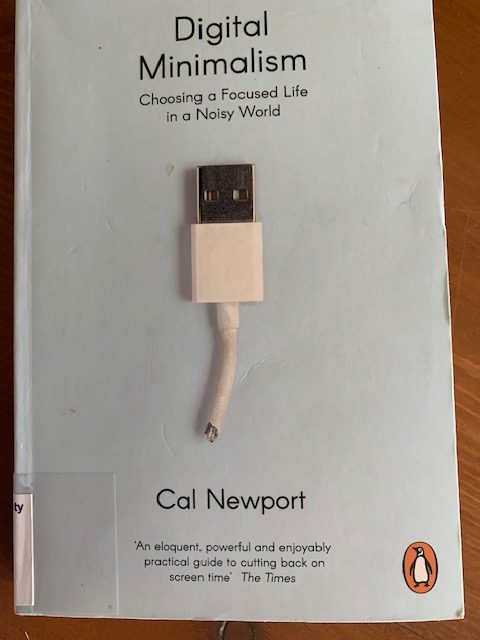
Cal Newport’s Digital Minimalism
The key to thriving in our high-tech world is to spend much less time on social media. This is Cal Newport’s persuasive message in his Digital Minimalism: Choosing a focused life in a noisy world (Penguin Business, 2019).
Newport is a succinct, logical writer who presents irrefutable evidence for his argument and outlines a feasible strategy with clear steps to follow if we want to reclaim (as Freedom app calculated) an extra 2.5 hours of productive time per day.
The evidence of the detrimental effects of social media have been accumulating steadily for years and Newport presents this clearly in his highly readable book. Rates of teenage anxiety, depression and suicides have skyrocketed. These shifts in mental health correspond exactly to the moment when American smartphone ownership became ubiquitous. Teachers notice that these teenagers ‘have lost the ability to process and make sense of their emotions, or to reflect on who they are and what really matters, or to build strong relationships, or even just to allow their brains to power down their critical social circuits, which are not meant to be used constantly …’ (p. 108)
Tobacco farmers in T-shirts
Newport quotes Bill Maher: ‘The tycoons of social media have to stop pretending that they’re friendly nerd gods building a better world and admit they’re just tobacco farmers in T-shirts selling an addictive product to children. Because, let’s face it, checking your “likes” is the new smoking.’ (p. 9)
The technology is not neutral. It’s engineered for users to spend long amounts of time because the longer you’re on it the more money they’re making. ‘Philip Morris just wanted your lungs,’ Maher concludes. ‘The App Store wants your soul.’ (p. 11)
What we can do about it
1. Newport suggests a digital declutter for 30 days to give you the space to refine your understanding of the things you value most. Then you carefully add back the positive online activities that enhance your life.
2. Secondly, walk. Every day. If you want to solve a problem, resist the urge to google it – go for a one hour walk instead. Without your phone and go alone. We need solitude to keep us sane. Balance this with face to face conversations. Social media takes time away from both these essential things. The heaviest social media users are statistically much more likely to be lonely and miserable.
Sherry Turkle in Reclaiming Conversation writes, ‘Face to face conversation unfolds slowly. It teaches patience. We attend to tone and nuance.’ Social media fosters none of these things. Turkle is not anti-technology; she’s pro-conversation.
Maybe this is why watching plays give us so much satisfaction – they’re all conversation. Screenplays and TV scripts too but to a lesser extent because of all the visual symbolism and subconscious clues available to cinema and TV show technology.
3. The third solution Calport suggests is asking a crucial question when you have achieved your 30 days without social media: Does this technology directly support something that I deeply value? He also advises, when back on social media, to never click Like.
He has many other suggestions, like pursue a new or forgotten craft or hobby. Some will realise that working with our hands gives us far more joy and satisfaction than phone scrolling. But the phone scrolling is hard to give up.
Why we become addicted
Millions of years of evolution has hard-wired us for survival to keep checking if we’re being accepted by our tribe. It’s a life or death instinct and Facebook and their ilk have used this to keep us checking our feeds. Those corporations use deliberate, highly sophisticated designs to keep us on our phones so that they can continue making billions from advertisers. When we constantly check our feeds we allow them to control more and more of our time, how we behave and how we feel. The digital minimalism strategy proposed by Newport puts new technologies to use for our best aspirations and not against them.
It’s all about awareness, like saving money is
Calport quotes Gary Rogowski’s Handmade: Creative focus in an age of distraction: ‘People have the need to put their hands on tools and to make things. We need this in order to feel whole.’ There are evolutionary reasons for this. Both authors believe that we should cultivate a high quality leisure life first and then we can do the digital stuff later in the day, rather than cut it out altogether. As long as our digital time is spent on worthwhile activities that actively support what we value most, no problem.
‘Your time = their money’
To prevent social media taking over our time (as it is specifically designed to do) Newport claims that it’s important to write down your objectives and strategies, otherwise it’s too vague. He outlines how to have a Weekly Planning Process and a Weekly Leisure Plan. And once a week review how well you did. You make a commitment, then see how realistic it turns out to be, and change it if necessary. It’s all about awareness, like saving money is.
The author advises deleting the social media apps from your phone. You don’t have to quit them; you just quit accessing them on the go. And Freedom or SelfControl apps will gain you an estimated 2.5 hours of productive time per day.
You can log onto Facebook or whatever once every three days or so to see friends’ and relatives’ photos or devise your own strategy to avoid mindless scrolling that eats up inordinate amounts of time. For slow news consumption choose high quality blogs rather than the ‘murky mess of Twitter/X.’ Or there’s AllSides.com that you can check once a day. It’s a news site that covers the top stories, for each one neutrally linking to three articles: one from a source associated with the political left, one from the right and one from the centre. It tends to prevent spikes in anxiety. Plus there’s the Light Phone, invented by Hollier and Tang, who say ‘Your time = their money.’ Then you will feel empowered to invest your time in things more important to you.
And you will be happier and feel better about yourself and the world, or at least (given the state of the world today) your contributions to that world.
If the internet collapsed …
Cal Newport’s position is far from being a Luddite; he teaches Computer Science at Georgetown University. His book is about using it in ways that benefit us. Read it and learn how to get more from life. The billionaires want us to be passive consumers. When we use the talents we have, when we go for walks and notice the beauty of the trees, when we make time to have real conversations with real people, when we make or improve things with our own hands, we lead a far happier, more satisfying life.
I was already doing some of what Newport advises. It’s easier for people my age, raised on books and magazines and films. If the internet collapsed tomorrow, we’d still know where to get information (and it would be more trustworthy) and we could easily entertain ourselves and each other. I wrote the first draft of this by pen on paper and I live in a country town where when I go for a walk I get solitude mixed with company – the inevitable face-to-face conversations with people I meet – because one knows everyone and the pace is slower; everyone has the time to talk. I’m probably more of Luddite than Cal Newport is. So read him. You’ll get a more balanced and realistic view. He’s written many books and the other one I’ve read, Slow Productivity, is also good. I’d read his New Yorker essays too. His other books sound intriguing: A World Without E-mail, So Good They Can’t Ignore You and Deep Work, for instance.
Leave a Reply