
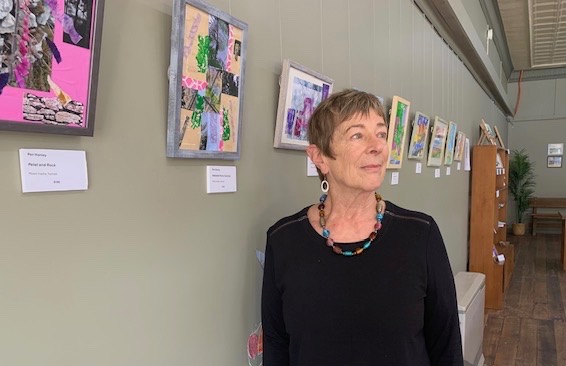
Why haven’t I written a blog for so long? It’s because I’ve been teaching another creative writing course and because I’ve contributed my collages to two more exhibitions (the one still on till the end of the month is in Dojo’s bread shop, main street of Braidwood) and I was cheered when one man stood in front of them for ages and said that my sense of colour was ‘superb’ (but he still didn’t buy one). Ha. Plus I have to spend time on knee exercises (El Paso clinic’s online ones – https://epmpt.mykajabi.com/knee-arthritis-recovery-program – are fantastic and also the Daily Om https://www.dailyom.com ones) and it all takes time.

Everyone I know is so busy – is it because we all must spend about two hours every day deleting and unsubscribing from unwanted emails?
Favourite podcasts
Plus I’m trying to paint our Gypsy van and get it finished by Christmas. We were able to resume the painting since temperatures have finally risen enough for the paint to work properly. While painting I like to listen to podcasts. Favourites of the moment are Drunk Women Solving Crime and BBC Sounds’ Life Changing. My other favourite I can always go to is British Scandal on Wondery. (Although when Matt Forde and Alice Levine attempt the notoriously difficult Australian accent they’re not good.) But they’re brilliant in every other way and I love them. I also love Julia Louis Dreyfus’ Wiser than Me.
Life is so full that I have signed up for online courses in art and even one on writing (I’ve sort of given that up but it would benefit my students) and some of them even cost money, yet I never have time to do them! It’s completely neurotic! Amidst all this, I must read every day. Sometimes – usually – I read before going to sleep, not a time when I’m at my sharpest. At the moment I’m reading Ian McEwan’s latest novel, What We Can Know and I am loving it. I can just relax into it and it is so funny. The world of an academic in the 1990s that the academic about a hundred years from then is researching is a world I knew intimately and McEwan recreates it so well.
Taxtopia by The Rebel Accountant
But the book that stands out in the last few months is one I found in the Canberra library system by someone who calls himself The Rebel Accountant. His Taxtopia: How I discovered the injustices, scams and guilty secrets of the tax-evasion game (Monoray, 2023) is riveting and funny and he has that enviable style where the reader feels as if she’s having a drink with him and he’s just conversing, in the most appealing, funny way. He has mastered making a dry, complicated subject accessible and interesting. Very few writers can do that. (Some writers can make intrinsically interesting material seem dry!)
Did you know that News Corps in UK paid no tax for the entire 1990s? And that indirect taxes – on products, not incomes – affect poor people far more than rich. Of course they do. You know that. This is the NeoLiberal system we are living in.
The author tells us that it’s hard to define what a company is. ‘But I’ve come to believe that an inability to appreciate what a company is (or worse, an unwillingness to) has led to some of the greatest injustices in the world economy.’ (187)
This is why you can’t buy a house
It’s the nebulousness of companies, their conceptualness, their lack of a clear definition, that makes them so hard to tax. ‘Obviously some of their directors cheat, but they don’t really need to. The laws don’t so much have loopholes; the laws are the loopholes.’ (189)
Companies are allowed to buy houses. They are recognised as legal persons. This is the reason why so many people can’t buy a house. In 2013 UK government introduced. a Mansion Tax. This was targeted at houses owned by companies. A UK born person has to pay stamp duties when they buy and capital gains tax when sell it and inheritance tax when die. But the British Government decided to exempt a foreign investor from all of these except the first round of stamp tax.
The effect on the Exchequer is staggering. The Lib Dems calculated that it must be £750 million but the author reckons it’s surely several times as much.
Nicholas Shaxson researched this and found that of the first 76 apartments sold in One Hyde Park – opposite Harrods where the penthouse one was for sale at £175 million – 54 were purchased via offshore companies. That’s well over a billion pounds of property in just one block of flats – owned by anonymous companies in tax havens.
Tax payable would only be the original stamp duty £15 million rather than £80 million. In just one block of flats the Govt has lost hundreds of millions in avoided taxes. And there are tens of thousands of super-prime homes owned by offshore companies. – Billions in taxes lost!
And if you rent your flat to an ‘unconnected third party’ you’re exempt from even the Mansion Tax.
- The anti-corruption org. Global Witness estimated in 2017 that 87,000 anonymously owned houses in the UK worth c £100 billion in tax revenues to benefit money launderers, gangsters etc. David Cameron said he’d do something, make people register so could see the real owners of properties, a Bill would be implemented in 2021, but nothing came of it.
Black holes all over London – and Sydney and New York and …
And I just loved this part of his explanation where he uses the metaphor of ‘black holes’ to allow us to see what is really going on.
‘… one of the main reasons you can’t buy a fancier pad is that almost all the best houses have been bought up by some offshore tax avoider at the top of the chain, aided by our tax and regulatory system.
‘If you could physically see this happening there would be black holes all over London, and increasingly the rest of the country too. Black holes where houses used to be.’ And same thing in other countries too all over the world this is increasing. More than half of American properties that sell for over £3 million are bought via companies.
Well that’s already too many words so I’ll leave you with that unpleasant image that sums up part of the massive injustice operating today (even without mentioning the larger, very recent political changes in the US that will make everything for everyone who is not extremely rich much worse in every way). No, I can’t end on that note. We have to continue to do what we love as much as we can, and remember that it’s now scientifically proven that it’s impossible to feel anxiety when we are being creative! So get out your pen or paints or clay or wood and make something out of your material plus your skill and experience, your memory and imagination – it feels so exhilarating. You can do it! And do it again and again, improving every time, as I see with my Kick-Start Your Creativity students. What a fabulous group of people they are and it’s such fun being with them.
Leave a Reply